
Mamata Backs CJP in NEET Protests
The Trinamool Congress chief backed the Cockroach Janta Party and condemned police “atrocities,” while the BJP accused the opposition of using the NEET agitation to push an “anti-national” agenda — opening a fresh front in Bengal.
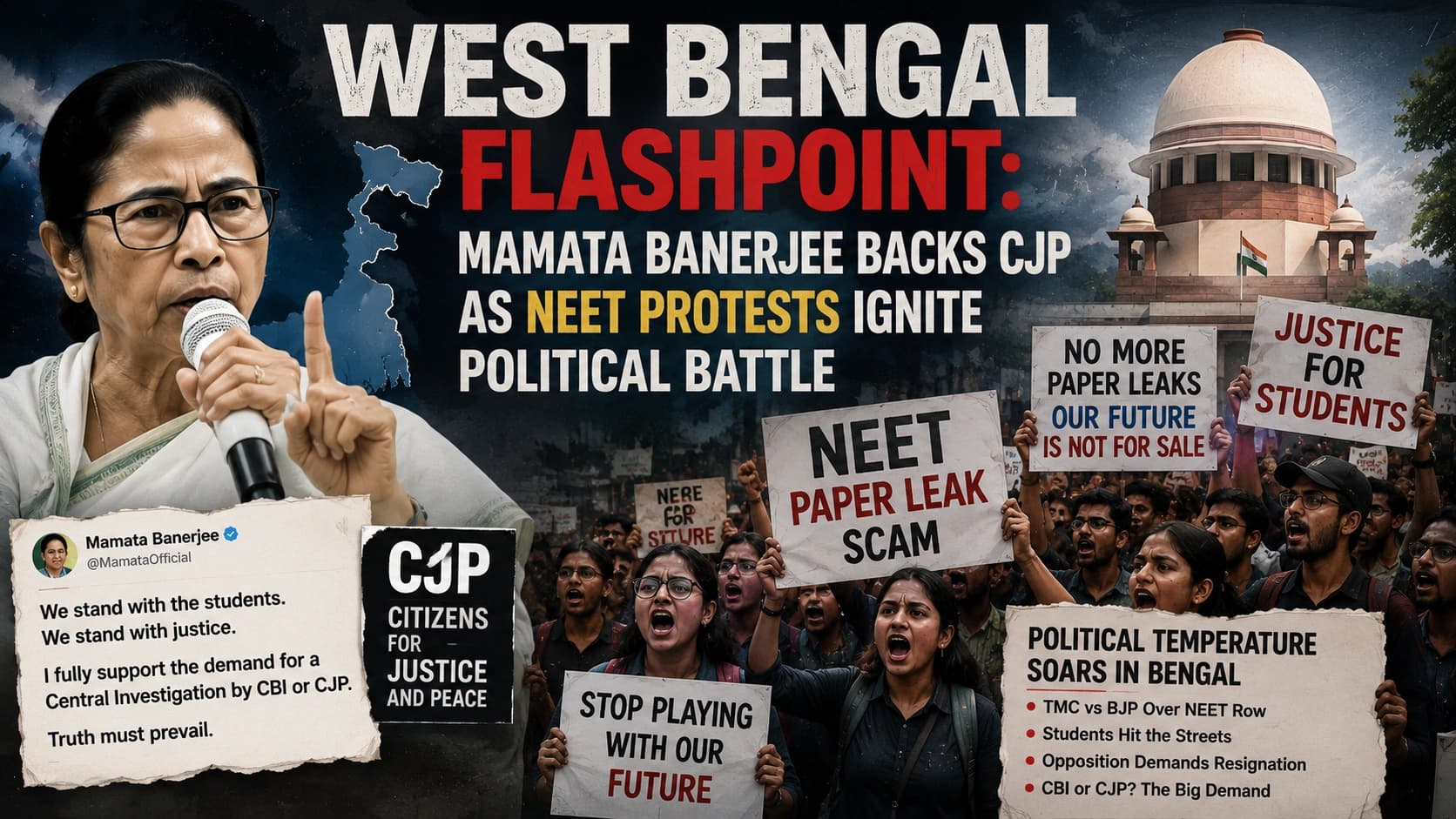
As the protests over the NEET-UG 2026 paper leak spread from Delhi across the country, West Bengal emerged as one of the sharpest political fronts — not because of the scale of street violence, as in Bihar, but because of the clash of narratives it produced. On one side stood Chief Minister Mamata Banerjee and her Trinamool Congress (TMC), which embraced the Cockroach Janta Party (CJP) movement and condemned the police response as an atrocity. On the other stood the Bharatiya Janata Party (BJP), which cast the agitation as a "politically motivated" and even "anti-national" campaign.
The result was to graft the national protest onto Bengal’s already combustible politics, turning the NEET issue into another arena of the state’s long-running confrontation between the TMC and the BJP.
Mamata Banerjee Throws Her Weight Behind The Protest
The Chief Minister was among the most prominent political figures to back the movement. According to WION, Mamata Banerjee backed the CJP-led protest over the NEET paper leak and criticised the Delhi Police action against protesters, issuing a strong statement against what she framed as police atrocities. Telangana Today (citing IANS) reported that Banerjee announced she would join the CJP’s NEET protest in New Delhi.
Her intervention gave the protest a heavyweight political patron and internationalised a movement that had, until then, been led largely by students and activists. By aligning the TMC with the CJP, Banerjee positioned herself as a national voice against the government’s handling of the leak and the protests — a role consistent with her ambitions within the opposition INDIA bloc.
TMC Leaders Amplify The Charge
Banerjee was not alone. TMC MP Sagarika Ghose criticised the central government for using tear gas against student activists protesting examination paper leaks, describing the action as "shameful," according to The News Mill. Other TMC leaders backed the students’ right to protest; National Herald quoted TMC leader Pratikur Rehman as saying it was "the right of the students to protest against corruption" and that they should not need permission, though they should intimate the police about their rally.
The BJP’s Counter-Offensive
The BJP mounted an aggressive rebuttal. According to UNI, the party on Thursday, 23 July, accused a section of the opposition of using the NEET protests to push a "politically motivated" and "anti-national" agenda. Free Press Journal reported that BJP leaders in West Bengal asserted the Delhi protests had escalated "beyond student issues," citing allegations of foreign funding and anti-national activities.
The ruling camp in the state also issued warnings. Lokmat Times reported that, against the backdrop of the protests, the ruling dispensation in West Bengal warned on Thursday that no attempt to create unrest in the state would be tolerated — a signal that any Bengal leg of the agitation would be closely policed.
A Rally In Kolkata
The movement, meanwhile, sought to establish a formal presence in the state. The CJP approached the Kolkata Police seeking permission to hold a rally from College Street to Rani Rashmoni Avenue on 24 July over the NEET paper leak and Sonam Wangchuk’s hunger strike, according to Telangana Today. The choice of route was symbolically potent: College Street is the historic heart of Kolkata’s student and intellectual life, and Rani Rashmoni Avenue has long been a favoured venue for political demonstrations in the city.
The permission request set up a test for the state authorities: how to handle a protest that the TMC broadly supports but that the BJP has sought to portray as subversive.
Solidarity From The Wider Opposition
The Bengal battle drew in opposition figures from beyond the state. NCP leader Supriya Sule criticised the Centre over the NEET-UG leak, calling it a "systemic failure" and demanding a thorough probe, while also condemning attacks on TMC leaders in West Bengal and expressing solidarity with Mamata Banerjee, according to Asianet News. The convergence illustrated how the NEET issue was knitting together disparate opposition parties around a shared grievance.
That solidarity was strategically significant. The INDIA bloc has often struggled to find issues on which its ideologically varied constituents can speak with one voice; the NEET leak, with its blend of youth aspiration and institutional failure, proved to be one such issue. By backing the Bengal protests and Mamata Banerjee personally, leaders from other states signalled that the agitation was being adopted as a genuinely national opposition cause rather than a regional flashpoint — raising the political cost for the government of letting the controversy fester.
Why Bengal Matters
West Bengal’s prominence in the NEET story is a function of its politics. As a state governed by a leading opposition figure with national ambitions, and as a perennial battleground between the TMC and the BJP, Bengal was always likely to become a stage on which the national protest was re-enacted as a local contest. The competing frames — "police atrocities" versus "anti-national agenda" — mirror the wider polarisation of Indian politics, with the student issue serving as the latest proxy.
For Banerjee, backing the movement offers a way to project leadership within the opposition and to attack the Centre on an issue with broad public sympathy. For the BJP, casting the protests as externally funded and anti-national is an attempt to blunt that sympathy and to reframe the agitation as a threat to order rather than an expression of legitimate grievance.
The Symbolism Of College Street
The CJP’s choice of route for its proposed Kolkata rally — from College Street to Rani Rashmoni Avenue — was steeped in meaning. College Street, home to Kolkata’s great educational institutions and its legendary book market, is the symbolic heart of the city’s student and intellectual life. Rani Rashmoni Avenue, a traditional venue for political demonstrations, is where Bengal’s movements have long converged. To march from one to the other is to stake a claim to Bengal’s distinctive tradition of student and intellectual activism.
That symbolism placed the state government in a bind. Having condemned police action against protesters in Delhi, the Trinamool Congress could hardly be seen to obstruct a peaceful student rally in its own capital. Yet the BJP’s framing of the movement as "anti-national" and its warnings about unrest created pressure to police any Bengal leg of the agitation closely. How Kolkata Police handled the permission request thus became a test of the TMC’s own commitment to the right to protest.
A Proxy For Bengal’s Larger War
The NEET issue did not arrive in Bengal as a neutral national story; it landed in the middle of an entrenched TMC–BJP rivalry and was immediately absorbed into it. For the TMC, championing the students offered a way to attack the Centre on an issue with broad sympathy while burnishing Mamata Banerjee’s national opposition credentials. For the BJP, portraying the protests as externally funded and subversive was a means of neutralising that sympathy and reframing the agitation as a law-and-order threat.
Banerjee’s parallel vow to fight in the Supreme Court to protect the Trinamool Congress’s name and symbol, reported by Telangana Today, underscored how the NEET agitation had become entangled with the broader existential contests of Bengal politics — a reminder that in the state, few national issues remain purely national for long.
What Comes Next
The immediate questions are whether the Kolkata rally proceeds and how it is policed, whether Mamata Banerjee follows through on joining the Delhi protest, and whether the BJP’s "anti-national" framing gains traction or backfires. The larger significance is that West Bengal has become a microcosm of the national debate — a place where the argument over the NEET leak is inseparable from the broader struggle over how India treats protest, and over who gets to define what counts as legitimate dissent.