
India and the Oil Shock: How Energy Security Held Up and the Risks That Remain
A decade of diversification and strategic reserves carried India through the Hormuz crisis without rationing. But with the rupee near 96, Brent restless and a weak monsoon now a rival macro risk, this is the wrong moment for complacency.
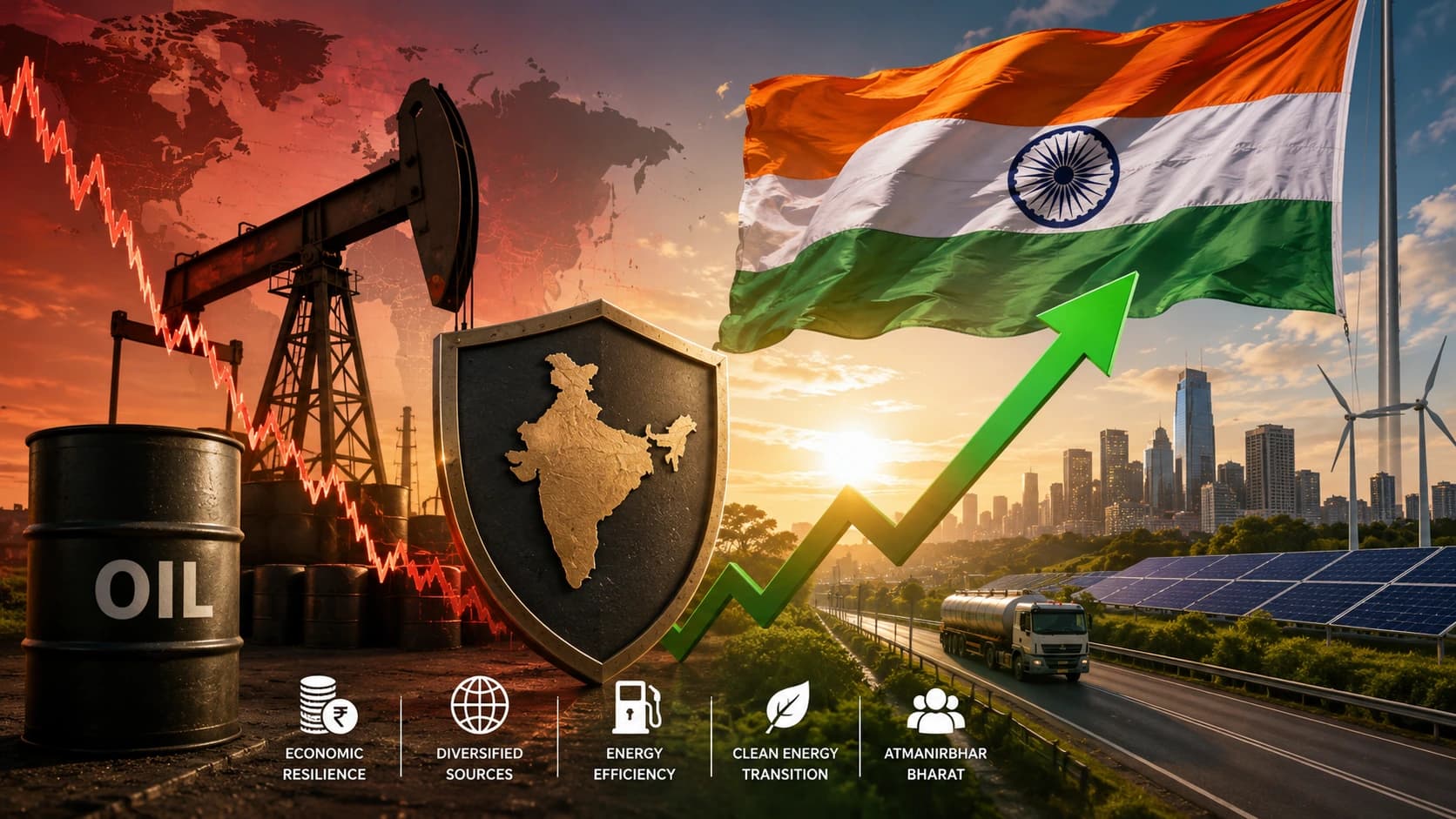
There is a version of the past year that India can tell with justified pride. A country that imports close to nine of every ten barrels of crude it burns, and that once sent roughly half of that crude through a single narrow waterway between Iran and Oman, lived through the closure of that waterway and the reignition of war in the Gulf — and did not ration fuel. Pumps stayed open. Factories kept running. The lights stayed on. For an economy this exposed, that is not luck. It is the payoff of a decade of deliberate choices.
But pride is a poor guide to policy, and the temptation now is to treat survival as vindication and vindication as licence to relax. That would be a serious mistake. India survived the oil shock because it had spent years preparing for one. The moment it concludes that the preparation is finished is the moment it becomes vulnerable to the next shock — which may not look like the last one at all.
The Scale Of The Exposure
Start with the raw vulnerability, because it is easy to forget once a crisis passes. India imports somewhere around 88 to 90 per cent of the crude oil it consumes, along with a large share of its cooking gas. Historically, about half of that crude transited the Strait of Hormuz, the chokepoint through which a fifth of the world's oil passes and for which there is no adequate alternative route. A country cannot be more exposed to a Gulf disruption than that.
When the Hormuz corridor effectively closed following the military strikes on Iran, India faced the question every import-dependent economy dreads: if the corridor is shut, who exactly do you buy from? The honest answer, a few years earlier, might have been catastrophic. That it was not is the story of what India built in the intervening decade.
What Worked: Diversification And Reserves
India's refiners did not wait for the crisis to react. Over the preceding years, and then aggressively as the Gulf destabilised, they pivoted away from Hormuz-linked barrels toward suppliers that could be reached without passing through the strait. Discounted Russian Urals became a mainstay, aided by sanctions arrangements that kept the barrels flowing. Purchases from the Atlantic Basin — the United States, Brazil, West Africa — and from Venezuela expanded to offset weaker Gulf flows. The logic was simple and sound: if one route can be closed, do not depend on it for half your oil.
Alongside diversification came reserves. India leaned on its strategic petroleum reserves to cushion the immediate disruption, buying time for supply chains to reroute. The International Energy Agency described the Hormuz closure as among the largest supply disruptions in the history of the oil market — and yet India, the archetypal vulnerable importer, avoided the rationing that such language would lead one to expect. Diversification spread the risk; reserves absorbed the shock. Both worked.
The lesson of the crisis is not that India is safe. It is that preparation paid off — and that the return on preparation is precisely why it must continue, not stop.
Why Complacency Is The Real Danger Now
Here is where pride becomes perilous. Having weathered the worst-case Gulf scenario, India could easily conclude that its energy security problem is solved. It is not. The vulnerabilities that made Hormuz so frightening have been managed, not eliminated, and new pressures are building precisely as attention drifts.
Consider the macro backdrop. The rupee has weakened to around 96 to the dollar, which mechanically inflates the cost of every imported barrel regardless of the dollar price of crude. Brent has been restless and prone to surging on each fresh escalation, and a sustained spike would widen the import bill, pressure the current account and feed inflation straight into household budgets. The diversification that saved India also has costs — concentration in Russian crude carries its own sanctions and pricing risks, and buying on volatile spot markets amid shifting sanctions is not a free lunch. Tactical resilience is not the same as structural security.
The Threat That Isn't Iran
And then there is the risk that has quietly moved up the list. For all the drama of the Gulf, the biggest near-term threat to India's macro stability may not be a war at all, but the weather. A weak monsoon — driven by El Niño conditions — has emerged as a rival to Iran as the top macro risk. The early-season numbers have been alarming: June rainfall ran heavily in deficit, and the cumulative shortfall stood around a quarter below normal in early July.
A failed or weak monsoon hits India through a different door than an oil shock, but it hits hard. It threatens agricultural output and rural incomes, pushes up food prices, and can force the very fuel-intensive responses — more pumping, more diesel for irrigation, more imports of food — that compound the energy bill. An economy managing an oil shock and a monsoon shock at once faces a far harder problem than either alone. That two of India's top macro risks are now energy and weather, and that they can interact, is exactly why declaring the energy problem solved would be reckless.
The Hidden Costs Of A Success
It is worth being clear-eyed about what diversification actually bought, because the headline of "no rationing" can obscure the price paid beneath it. Leaning heavily on discounted Russian crude tied India's supply to a source that carries its own political and financial hazards — sanctions that can tighten without warning, secondary-sanctions threats against Indian firms, and payment and insurance frictions that add cost and complexity to every cargo. A discount is not a discount if the barrel becomes impossible to pay for or ship.
Buying more heavily on volatile spot markets, rather than through long-term contracts, brought flexibility but also exposure to price swings at the worst possible moments. And the very act of rerouting oil around Hormuz lengthens voyages, raises freight and insurance costs, and thins the margins of India's refiners. None of this shows up in the reassuring topline of pumps that stayed open, yet all of it is a standing bill that India keeps paying for its resilience. Recognising that bill is the difference between genuine security and the comfortable illusion of it — and it is the strongest practical argument against treating the crisis as closed.
What India Must Do Next
The prescription follows directly from the diagnosis. The strategy worked; the strategy must therefore be deepened, not paused. Four priorities stand out.
- Accelerate strategic reserves: the reserves cushioned this shock, but India's strategic petroleum reserve capacity remains modest relative to its consumption and its exposure. Expanding storage — and keeping it full — is among the cheapest insurance policies available against the next disruption.
- Press the green-energy transition: every unit of energy generated at home from solar, wind and other renewables is a unit that cannot be held hostage by a chokepoint. The most durable answer to import dependence is to import less, and the energy transition is as much a security strategy as an environmental one.
- Raise domestic production: India's own oil and gas output has long underwhelmed relative to its needs. Reviving domestic exploration and production, and improving recovery from existing fields, reduces the volume that must be sourced through contested waters.
- Keep routes and suppliers diversified: the diversification that saved India must not calcify into a new dependence — on Russia, or on any single source. Maintaining genuinely diverse suppliers and non-Hormuz routes preserves the optionality that is the essence of resilience.
The Broader Lesson
There is a temptation, common to governments and commentators alike, to treat a crisis survived as a crisis over. The oil shock of 2026 should teach the opposite lesson. India did not stumble through by good fortune; it walked through on a bridge it had spent a decade building — of diversified suppliers, alternative routes and strategic reserves. The bridge held. That is the argument for building more of it, not for putting down the tools.
Energy security is not a destination but a discipline. The countries that get badly hurt by oil shocks are rarely the ones that planned for them; they are the ones that assumed the last calm would last. India has just demonstrated, at considerable stakes, that preparation is the difference between disruption and disaster. To coast now — with the rupee soft, Brent twitchy, and the monsoon threatening a second front — would be to forget the very lesson the crisis just taught.
The Bottom Line
India survived the oil shock, and the manner of its survival deserves recognition. A decade of diversification and reserve-building did exactly what it was designed to do. But the correct response to a strategy that worked is to invest in it further, not to congratulate oneself and stop. The next shock — whether it comes from a strait, a sanction, an exchange rate or a failed monsoon — will test the same defences. India should spend the calm strengthening them, because complacency, not crude, is the real threat now.