
PM's Midnight Video: New Anti-Paper-Leak Bill and Fast-Track Courts Announced
In a self-recorded video posted shortly before midnight on July 23, the Prime Minister said a draft law was ready for Cabinet approval and would be introduced in Parliament next week — hours after fast-track courts for paper-leak cases were notified.
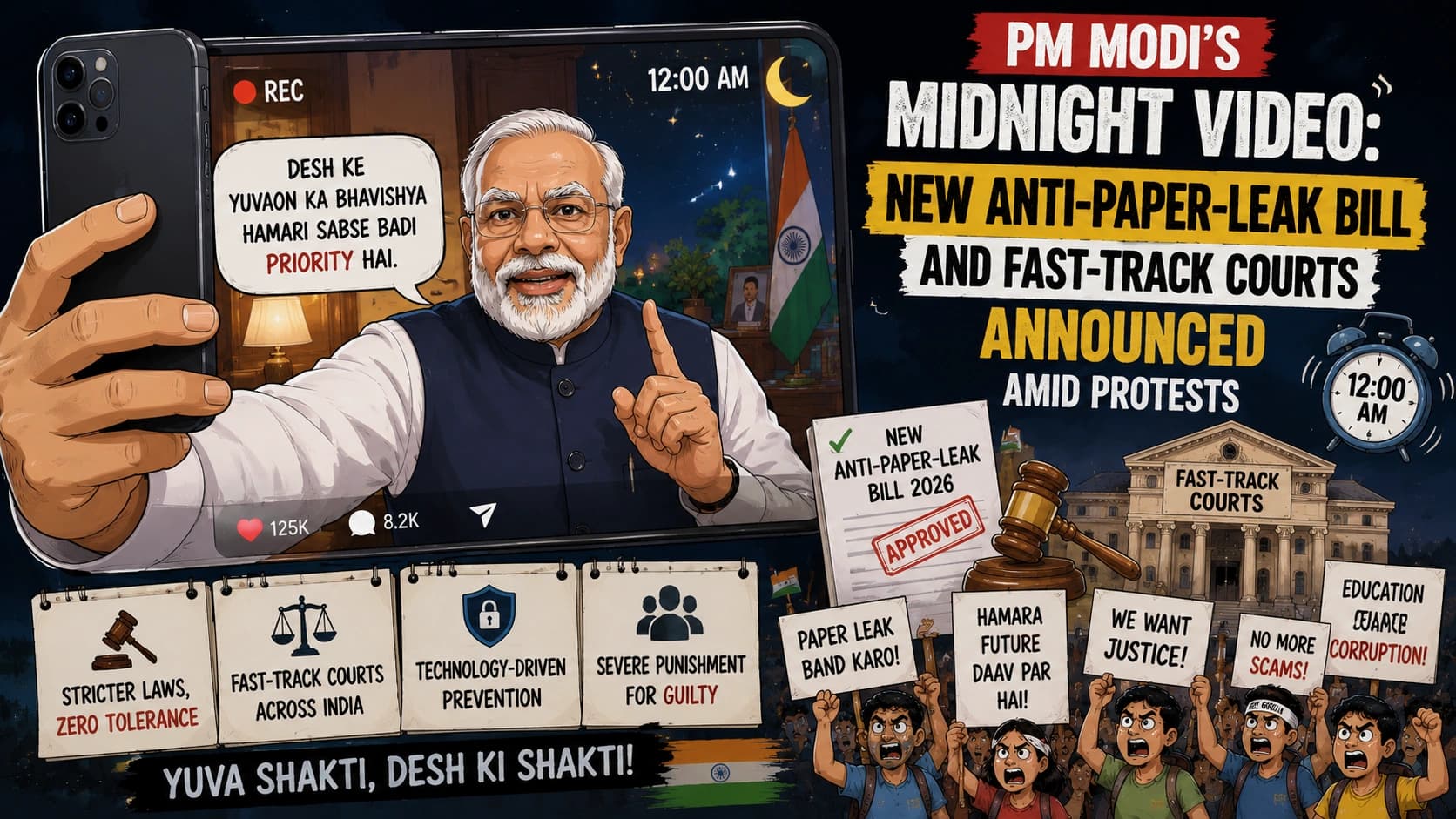
With protests over the NEET-UG 2026 paper leak showing no sign of easing, Prime Minister Narendra Modi took the unusual step of addressing the country directly in a self-recorded video message posted shortly before midnight on Thursday, 23 July 2026. In the nearly three-minute clip shared on social media, the Prime Minister said the government had prepared draft legislation to deal more effectively with examination leaks, that it would be placed before the Union Cabinet on Friday, and that it would be introduced in Parliament when the second week of the Monsoon Session begins on Monday.
"I am well aware that the issue of paper leaks is not a small matter. It causes immense distress to lakhs of students and their parents," the Prime Minister said in the message, as quoted by The Indian Express and other outlets. The timing — late at night, mid-agitation — underscored how seriously the government was taking a movement that had spread from Jantar Mantar to cities across the country.
What The Prime Minister Announced
The video message capped a day of announcements. According to Times of India, the Prime Minister said the government would bring in "more strict actions against paper leaks," that the Union Cabinet would discuss the stringent measures on Friday, and that the government would try to get the Bill passed in Parliament in the coming week. The Hindu reported that Modi also said the government had decided to set up fast-track courts for paper-leak cases to ensure swift and stringent punishment.
In a written post accompanying the announcements, the Prime Minister framed the move around students’ futures, saying, as quoted by OpIndia, that "nothing is more important than the welfare and future of our youth" and that fast-track courts had been decided upon to ensure swift and stringent punishment for those involved in leaks.
Fast-Track Courts Notified Within Hours
The promise of fast-track courts was not left as rhetoric. Within hours of the Prime Minister’s announcement, the Delhi High Court designated a special fast-track court — at the Rouse Avenue Court Complex, according to LiveMint and India Today — to exclusively try offences related to paper leaks and other unfair means in public examinations. India Today reported that the Delhi High Court named Justice Anu Grover Baliga to head the fast-track court, placing Delhi among the first jurisdictions to operationalise the move.
Law and Justice Minister Arjun Ram Meghwal said the government would set up fast-track courts in the High Courts of Bombay, Calcutta, Delhi and Madhya Pradesh to decide pending cases relating to the NEET examination paper leak, with the stated aim of sending those responsible to jail as quickly as possible, The Indian Express reported.
The Existing Law
The measures build on an existing statute. The Public Examinations (Prevention of Unfair Means) Act, 2024 already provides for stringent action against paper leaks, cheating and other malpractices in public examinations conducted by central agencies. As NDTV noted, the anti-cheating law provides for imprisonment of up to five years and a fine of up to Rs 10 lakh for those found guilty. The new Bill, the government has signalled, is intended to toughen this framework further.
The Opposition’s Rebuttal
The opposition was quick to cast the midnight video as deflection rather than accountability. Leader of the Opposition Rahul Gandhi, in a video shared on X late on Thursday night, accused the Prime Minister of insulting students’ intelligence, Times of India reported under the headline "Don’t insult students’ intelligence." The opposition’s core argument is that new courts and tougher penalties, while welcome, do not address the central demand of the protests: political accountability at the top, in the form of Education Minister Dharmendra Pradhan’s resignation.
For weeks, the Congress and its allies have argued that a leak-proof system requires more than prosecution of the individuals who leaked a paper; it requires answerability from the minister and the overhaul of the testing agency responsible. From that vantage point, fast-track courts prosecute the symptom while leaving the question of responsibility untouched.
Why The Government Moved
The sequence of announcements — fast-track courts, a promised Bill, and a direct-to-camera appeal — reflects a government trying to seize the initiative on an issue that had escaped its control. By acting visibly and quickly, the Centre sought to demonstrate responsiveness to students’ anxieties while denying the opposition a monopoly on the grievance.
There is also a parliamentary calculation. With the Bill slated for introduction in the second week of the Monsoon Session, the government can shift the debate from the street to the floor of the House, where its numbers are stronger and where it can frame the conversation around legislation rather than resignation. Whether that manoeuvre works depends on whether students and the opposition accept the Bill as a genuine remedy or read it as a change of subject.
How The New Bill Builds On The 2024 Act
The promised legislation does not arrive in a vacuum. The Public Examinations (Prevention of Unfair Means) Act, 2024 already criminalises organised cheating, paper leaks and other malpractices in public examinations conducted by central agencies, providing for imprisonment of up to five years and fines of up to Rs 10 lakh, as NDTV and India Today have noted. The government’s message is that this framework, while robust on paper, has not delivered swift convictions — hence the twin emphasis on a tougher new Bill and on fast-track courts to clear the backlog of pending cases.
The fast-track court mechanism is designed to attack the problem of delay. By designating dedicated courts — beginning with Delhi’s Rouse Avenue complex and extending, per Law Minister Arjun Ram Meghwal, to the High Courts of Bombay, Calcutta, Delhi and Madhya Pradesh — the government aims to ensure that leak cases are not lost in the general pendency that afflicts Indian courts. The naming of Justice Anu Grover Baliga to head the Delhi fast-track court, within hours of the Prime Minister’s announcement, was meant to signal urgency.
The Political Timing
The choreography of the announcements — fast-track courts by day, a video message by midnight, a Cabinet discussion the next morning — was as much political as administrative. It allowed the government to project momentum and control at a moment when the initiative appeared to have passed to the streets. Speaking directly to camera, rather than through a ministry press note, was a calculated attempt to communicate empathy to a young audience that consumes news on social platforms.
Yet the very speed invited scepticism. Critics asked why, if the tools existed under the 2024 Act, convictions had not followed sooner, and whether a flurry of late-night announcements amounted to substance or stagecraft. That tension — between visible action and genuine accountability — sits at the heart of the political contest the video was meant to address.
What Comes Next
The immediate milestones are clear. The Union Cabinet was set to take up the draft law on Friday; the Bill is expected to be introduced in Parliament in the week beginning Monday; and the newly notified fast-track courts, beginning with Delhi’s Rouse Avenue court, will start hearing pending paper-leak cases. Each step will be scrutinised for substance as much as speed.
The deeper test is one of trust. A video message and a new law can signal intent, but the students on the streets have made clear that they are measuring the government against a single yardstick: accountability. Until the question of who is answerable for the leak is resolved to their satisfaction, the legislation — however stringent — is unlikely, on its own, to end the agitation.