
A Cockroach Joke Forced Out a Minister
The Cockroach Janta Party did in five weeks what years of formal opposition could not. That is a triumph for accountability — and a flashing warning light for every institution that still assumes legitimacy flows only from formal recognition.
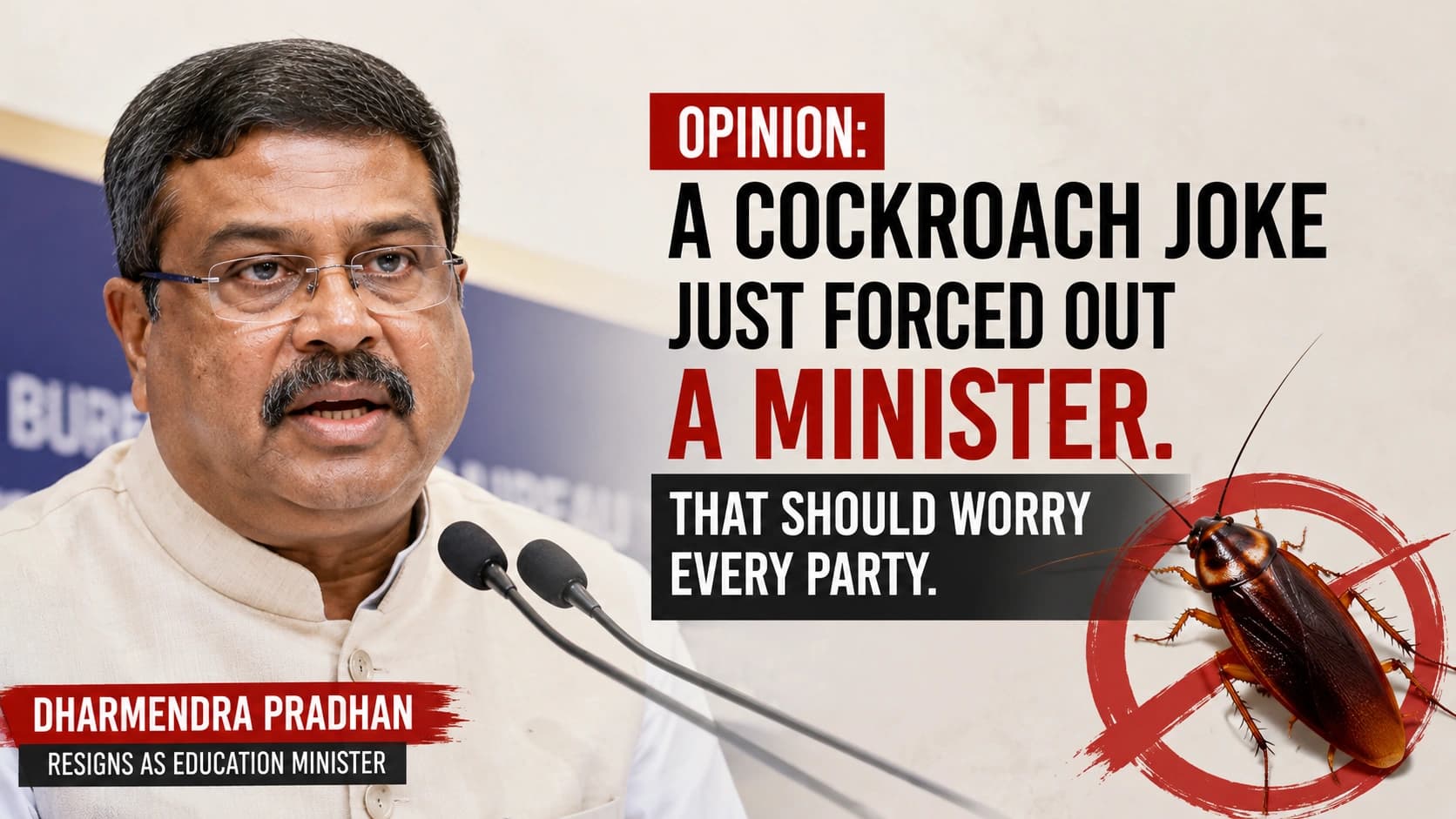
There is a comfortable story available about Dharmendra Pradhan's resignation, and much of the coverage this week has told it: a government mishandled an exam, students got angry, they protested, and accountability won. That story is true, but it's also incomplete, and what's left out is more important than what's included. What actually happened is that a satirical online joke, with no registered party status, no recognized leadership structure, and no institutional standing whatsoever, outperformed India's entire formal opposition apparatus at the one thing that apparatus exists to do: hold the government to account.
That should trouble everyone who has a stake in how India's institutions function. The outcome was not wrong, but it highlights the growing gap between where legitimacy is supposed to reside and where leverage actually lives.
Give The Devil His Due
Start with what the Cockroach Janta Party got right, because it is considerable. Abhijeet Dipke's movement identified a genuine grievance — a cancelled medical entrance exam that upended the academic year for more than 22 lakh students — and built, in a matter of weeks, a durable public campaign around it: a manifesto, a consistent brand, a physical protest presence at Jantar Mantar, and the discipline to hold to two non-negotiable demands rather than diffusing into a grab-bag of complaints. It absorbed the hospitalization of an allied hunger striker without collapsing. It survived allegations of foreign funding, which the Ministry of External Affairs ultimately had to publicly deny. And It got the result it wanted, forcing the resignation of a sitting Union minister in circumstances the Modi government had avoided
Judged purely on effectiveness, this is one of the more successful single-issue political campaigns India has seen in a decade. It deserves to be studied rather than dismissed as internet ephemera.
The lesson is not that memes are more powerful than institutions; rather, it highlights the growing gap between where legitimacy is supposed to reside and where leverage actually lives. It is that institutions have been coasting on assumed authority they no longer automatically command.
Where Parliament Failed First
Now hold that success against the record of the actors whose job this technically was. India's Opposition parties spent more than six weeks demanding Pradhan's resignation before Parliament even reconvened, through the ordinary channels of statements, press conferences and procedural motions, without visible effect. Once the Monsoon Session opened, the Opposition's tool was the parliamentary deadlock — adjournment after adjournment, refusing all other business — a blunt instrument that succeeded mainly in freezing the government's own unrelated legislative agenda rather than in isolating Pradhan specifically. It is entirely plausible, on the public record, that Pradhan would still be in his post today absent the sustained street pressure the CJP generated in parallel.
This is not a partisan point about any particular party's competence. It is a structural point about what formal opposition in India's system has been reduced to: procedural friction, symbolic walkouts over seating arrangements, and demands repeated in Parliament until a government's patience or a movement outside it — not the parliamentary process itself — forces a change. When a satirical collective with no seats in either House achieves in five weeks what the Opposition's formal apparatus could not in six, that is not a compliment to the movement so much as an indictment of the apparatus.
The Legitimacy Question Nobody Wants To Ask
Here is the uncomfortable question this episode raises, and it applies well beyond this one government or this one movement: if political outcomes are now substantially determined by which side can generate the most sustained, visible, media-friendly street and online pressure — rather than by the deliberative and representative processes formal democratic institutions are meant to provide — what exactly is the ongoing value proposition of those institutions? A registered party's claim to represent constituents through elected seats. A recognised union's claim to represent workers through collective bargaining structures. A civil society organisation's claim to expertise and standing built over decades. All of these rest on an assumption that formal recognition confers a kind of legitimacy that ad hoc movements lack.
The Cockroach Janta Party's success suggests that assumption is eroding faster than institutions have adjusted for. It is not that Dipke's movement is somehow more "legitimate" than the Congress or the wider INDIA bloc in any constitutional sense — it plainly is not, and it does not claim to be, having deliberately avoided registering as a political party with the Election Commission. It is that legitimacy in the constitutional sense and leverage in the practical sense have become two different currencies, and the second increasingly decides outcomes regardless of how much of the first an actor holds.
The Risk On The Other Side Of The Ledger
None of this is an argument for nostalgia about institutional gatekeeping, and it would be a mistake to read it that way. Formal structures — parties, unions, courts, established civil society — exist in part to slow down majoritarian or populist impulses, to provide continuity and expertise, and to be accountable in ways that a leaderless online movement, almost by design, is not. The CJP itself has no mechanism by which it can be voted out, sanctioned for false claims, or held to the kind of transparency requirements that govern registered parties and civil society organisations. Its strength — speed, adaptability, immunity from institutional capture — is also, structurally, an accountability gap. A movement that can force a resignation in five weeks with no formal governance structure of its own is not obviously a healthier long-run substitute for the institutions it is currently outperforming.
That tension is precisely the point. This episode should not be read as evidence that spontaneous movements are simply better than parties and institutions. It should be read as evidence that institutions have let the gap between their formal authority and their actual effectiveness grow dangerously wide, and that gap is now being filled by actors with none of the accountability structures those institutions were built to provide.
What Institutions Should Take From This
The practical lesson for every established political and civic actor watching this unfold is not to imitate the CJP's aesthetics — the satire, the branding, the deliberate absurdity — but to internalise what made it effective underneath the aesthetics: a single, clearly stated, non-negotiable demand; sustained visible pressure rather than episodic statements; and a willingness to hold a position for weeks rather than days. Formal opposition parties, in particular, might reasonably ask why a leaderless online collective could sustain focused pressure on one demand for five weeks when a Parliament session with actual institutional power struggled to do the same.
The government, for its part, should take a different lesson: that the absence of a formally recognised opposing structure is no longer a reliable signal that a grievance lacks the capacity to become an existential political problem. Dismissing a movement because it has no seats, no registration, and no identifiable leader accountable through conventional channels is, on this week's evidence, a serious miscalculation.
A Verdict, Not A Celebration
Pradhan's resignation is a legitimate outcome, arrived at through legitimate, if unconventional, means, in response to a genuine institutional failure at the National Testing Agency. That much is worth stating plainly and without cynicism. But the manner of its arrival is a warning, not a triumph, for anyone who believes India's formal democratic institutions should be the primary vehicle through which accountability gets delivered. This time, a joke about cockroaches did the job those institutions were built to do. There is no guarantee the next movement filling that gap will be animated by anything as benign as exam reform.